|
|
| Web Log | |
| Marriage |
Here is Brunner on marriage among the Geistigen: This is surely the alpha and the omega of the Gemeinschaft der Geistigen. |
| Kabbalah and feminism |
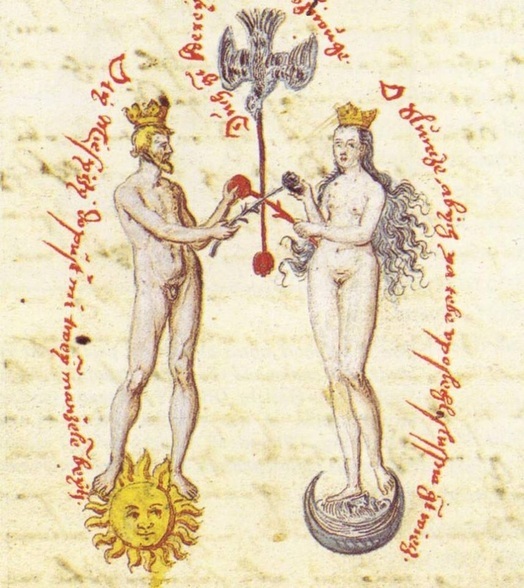
Harry Waton concludes The Philosophy of the Kabbalah with a startling affirmation of feminism: What a satisfaction it is to see feminism integrated into the whole matrix of social/spiritual progress, indeed as its ultimate objective Art work by Andrew A. Gonzales |
| Fractal architecture |
Josean Figueroa (previously), has a new book entitled Wright - Klumb: Fractal Integral Architecture. My interest in intellectual life was reawakened when I found at a local library Benoit Mandelbrot’s The Fractal Geometry of Nature. This book initiated my quest to integrate mind, nature and science. Part of this quest involved delving into architecture, which led to a deep appreciation for Frank Lloyd Wright. It is most satisfying to see this all coming together in Josean’s work. |
| Schleiermacher |
Friedrich Schleiermacher provides much to help guide the Gemeinschaft der Geistigen. In On religion : speeches to its cultured despisers, he carefully differentiates between true religion and priestliness from the mere imitation thereof. Acknowledging that imitation dominates the culture, he provides advice for those who want to live authentically spiritual lives. He writes: Thus, in times when spirit is hounded from the world at large, each inspirited home can serve as an island sanctuary, a nucleus for growth and a point of connection within the global Gemeinschaft der Geistigen. |
| Geistigen und Volk |
Human history is centered on the war between those who assert that man is spirit made flesh and those who oppose this view. The leaders of the first group are the great spiritual geniuses: Moses, Socrates, Christ and Spinoza. Men like Marx further their work. On the other side stand the masses who, under their scholarly leaders, deny the spiritual nature of man and of the world. The work of the Geistigen is to constitute themselves as a community for self-protection from the Volk. By separating the Geistigen from the Volk, détente will replace antagonism between the two groups. This in turn will allow the Volk to become ever more aligned with the Geistigen against the pseudo-elites of economics, politics, religion and scholarship, leading ultimately to the establishment of a true social/spiritual democracy. |
| C. Wright Mills |
C. Wright Mills is a titan of social spirit, a true rarity in the American landscape of the twentieth century. He writes: You've asked me, 'What might you be?' Now I answer you: 'I am a Wobbly.' I mean this spiritually and politically. In saying this I refer less to political orientation than to political ethos, and I take Wobbly to mean one thing: the opposite of bureaucrat. […] I am a Wobbly, personally, down deep, and for good. I am outside the whale, and I got that way through social isolation and self-help. But do you know what a Wobbly is? It's a kind of spiritual condition. Don't be afraid of the word, Tovarich. A Wobbly is not only a man who takes orders from himself. He's also a man who's often in the situation where there are no regulations to fall back upon that he hasn't made up himself. He doesn't like bosses –capitalistic or communistic – they are all the same to him. He wants to be, and he wants everyone else to be, his own boss at all times under all conditions and for any purposes they may want to follow up. This kind of spiritual condition, and only this, is Wobbly freedom.—C. Wright Mills: Letters and Autobiographical Writings, p. 252 This is a beautiful manifesto of spiritual/social emancipation. I thank my father, a life-long devotee of Mills, for bringing this great man to my attention. |
| Gemeinschaft der Geistigen—constitution |
I have come up with a basic set of principles, components and activities for the Gemeinschaft der Geistigen:
PrinciplesI am using this constitution to guide my work with my group here in Edmonton. |
| The Nearings |
[T]he urgent human need is not greater freedom, but a crusade led by a dedicated minority to perform tasks that demand knowledge, training, experience and disciplined group action. Freedom is not enough. The power age is in desperate need not so much of free men and women as of disciplined, responsible, dedicated citizens.—Freedom : promise and menace; a critique on the cult of freedomCan the essential principles of the Nearings’ quest for the good life be applied in an urban environment? What do we require to build a truly social economy? These are the questions that must be addressed in any attempt to establish a Gemeinschaft der Geistigen. |
| Genera and praxis |
What is the practical benefit to the proletariat of consciousness of the genera? Here is Marx:
Only when the real, individual man re-absorbs in himself the abstract citizen, and as an individual human being has become a Gattungswesen [generic essence] in his everyday life, in his particular work, and in his particular situation, only when man has recognized and organized his “own powers” as social powers, and, consequently, no longer separates social power from himself in the shape of political power, only then will human emancipation have been accomplished.—On the Jewish questionTo achieve emancipation, man must understand himself as a generic essence. To do that, he must see himself in relation to the other generic essences, as one generic essence among the infinity of generic essences. |
| Intuition and interrelation |
Harry Waton takes the same position as Brunner and Spinoza on the primacy of intuition in understanding the other genera, or as Waton calls them, realities: Intuition perceives individual realities, but not the relations among them. On the other hand, reason perceives the relations among the realities, but it does not perceive the individual realities themselves. Intuition must first perceive the individual realities that reason may afterwards perceive the relations among them. Intuition supplies the substance of knowledge, and reason supplies the form of knowledge. When intuition and reason cooperate, only then is knowledge born.—A true monistic philosophy v. 1, p. 102Waton is unique in stressing the importance of the interrelationship of the genera. He writes: The nature of a reality manifests itself only in its interrelation and interaction with other realities.— A true monistic philosophy v. 2, p. 410.This is an advance toward the scientific application of the core doctrines of Spinoza and Brunner. It serves as the fundamental principle of ecology. Our self-conception can only be formulated as a relation with other forms of being. To the extent that we deny qualities to other beings, we deny them to ourselves. If we deny that other entities think, then we deny that property to ourselves. If we deny that there is anything essential to other entities, then we deny that to ourselves. Perhaps we need an inverted golden rule: What you do unto others, you do unto yourself. |
| Scientific fantasy and scientific intuition |
How do we gain knowledge about the consciousness of other beings? By observing their form and motion. But does observation of the form and motion of other beings lead to knowledge of their consciousness? Observation can never provide certainty that other beings think. Only imagination can do this. Brunner calls it “scientific fantasy”: We may hold before our eyes glasses that will make our things appear larger or smaller, or coloured-nothing else. But to hold the senses and the nervous system of another animal like glasses before our eyes, in order thereby to achieve a kind of viewing and a thinking of things different from the human—that is unfeasible…. [T]his other imagining, however, is a comparing the representation of our attribute with other attributes for which we entirely lack any manner of representation. A representation is as little valid for other attributes, after all, as for the substance. Hence this comparing is no actual comparing and therefore this imagination is no actual imagination of how but only of that—fairy tales that cannot be told—which nevertheless now occupies, as fantasy, a place in our consciousness.—Science, spirit, superstitionThis speculative scientific fantasy proceeds on the basis of analogy between our own thought and that of the other genera: From analogy we derive the imagery necessary to the concept and thus arm the concept from the armour of our relative Practical Understanding. Completed is the concept of relative infinites, and we can now line up and compare the infinity of our world with the innumerable infinites of the other worlds (innumerable as numbers)—we have the all of infinities.—Science, spirit, superstitionIn Brunner’s view, this is the core of Spinoza’s philosophic project. Indeed, Spinoza’s principle of scientific intuition, the highest form of knowledge, is made intelligible as Brunner’s scientific fantasy of the genera from within. In terms of practical science, what this means is that we first know intuitively that the genera think, and then from their form and motion we derive clues as to how they think. |
| Geistigen and Volk |
The Volk craves spiritual awakening, but it cannot accept it as such. Spirit must mask itself as practicality in order to find its way into the thought of the multitude. Only through science can spirit present itself as practicality. What is meant, then, by science as the outer form of spirit? Let us look again at what Feuerbach says: Die Wissenschaft ist das Bewußtsein der Gattungen.What are the genera? Here is Spinoza: The second [kind of definitions] are those [of things] which do not exist through themselves, but only through the attributes whose modes they are, and through which, as their genus, they must be understood.—Short treatise.Thus the genera are the means by which the attributes are understood. What are the attributes? They are the forms of infinite and eternal Beingness. Thus science is consciousness of the forms of infinite and eternal Beingness. What is consciousness? Here, again, is Spinoza: [M]an conceives a human character much more stable than his own, and sees that there is no reason why he should not himself acquire such a character. Thus he is led to seek for means which will bring him to this pitch of perfection, and calls everything which will serve as such means a true good. The chief good is that he should arrive, together with other individuals if possible, at the possession of the aforesaid character. What that character is we shall show in due time, namely, that it is the knowledge of the union existing between the mind and the whole of nature…. Thus it is apparent to every one that I wish to direct all sciences to one end and aim, so that we may attain to the supreme human perfection which we have named; and, therefore, whatsoever in the sciences does not serve to promote our object will have to be rejected as useless.— Improvement of the intellectConsciousness, then, is knowledge of the union existing between the mind and the whole of nature. Taken all together, then, science is knowledge of the consciousness of the different genera. How can we gain knowledge of the consciousness of the different genera? By observing their form and motion. In this formulation, all scientific observation has only one goal, namely, to understand the consciousness of the genera. Notice how this inverts the usual scientific formulation wherein the observation of form and motion is posited as the end goal of science, and the question of consciousness is left as an unexplained remainder. Can the Volk come to see that science is about the consciousness of the genera? Perhaps not. But at the very least engagement on this ground provides the only viable means of bringing the Volk to the life of the spirit. |
| Grünewald |
Martin Rodan has published an article on Matthias Grünewald. Brunner called Grünewald, “the only significant German painter deserving of the name” (Our Christ, p. 271). This article by Rodan is certainly magnificent and important in its own right, and deserves a detailed treatment which I plan on providing here. For the moment, however, I will only say how pleased I am about the reference to Proust and his contemplation of Vermeer’s View of Delft. For one thing, I am a great fan of Proust. I recently completed reading his master work, which I started in the summer of 1986. When I mentioned this to Rodan, he told me that he considers Proust’s book a true "geistiges Kunstwerk." I hope that Rodan will publish something on that subject. I must also say that some of my most cherished memories are from the day I spent with Rodan in Delft itself; and then at the Mauritshuis in Den Haag, where we sat together in contemplation before Vermeer’s masterpiece. |
| Social Dynamics: Movement |
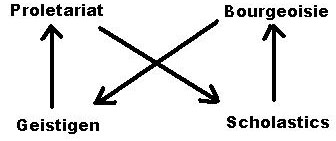
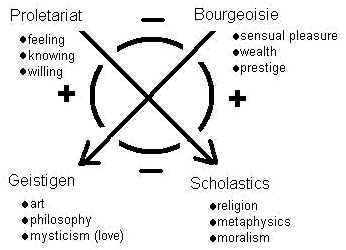
The movement of human consciousness is from the naïveté of the practical understanding (ie. the proletariat) to spiritual awakening that is distorted by scholasticism, then to bourgeois values, then to a self-purifying authentic spirituality and finally a return to the practical understanding buttressed by the preceding movements. This dynamic is expressed schematically as follows:
Many scholastics certainly see themselves in opposition to the bourgeoisie. However, the fact remains that the scholastic value system can do nothing but validate the bourgeois value system. Indeed, the bourgeois value system is nothing other than the operationalization of the scholastic value system. Reciprocally, the bourgeoisie justifies its values through scholastics. In the other case, the Geistigen seem entirely disruptive of the proletariat. The fact remains, however, that the proletariat needs and desires disruption, ie. spiritual awakening. At the same time, the way of life of the proletariat is utterly alien to the Geistigen. However, the Geistigen can freely adopt the external forms of the proletarian life while maintaining their own inner spiritual freedom from external forms. This allows the Geistigen to pass as proletarians, and thereby escape hostile targeting on the part of the Volk. It also allows the Geistigen to fulfill their mission to encourage and direct the spiritual awakening of the proletariat. |
| Feuerbach |
Brunner writes: Feuerbach, with wonderful energy and clarity – continuing and perfecting Hegel’s ideas – has made crucial and indispensable statements on the essence of religion, on the origin of God out of man and on theology as anthropology. Absurd, however, are his materialistic conclusions (as we shall see in our ensuing discussion of the Cogitant in us) and his perverted identification of the consciousness of God with that of the human species.—Our Christ, p. 409.Brunner here identifies the two main problems with Feuerbach: materialism and anthropocentrism. Marx, as we have seen, also took issue with Feuerbach. However, Marx saw him as not materialist enough and not anthropocentric enough. This is precisely the ground upon which Brunner and Marx exist in contrast to each other. Originating from the same Spinozist/Hegelian/Feuerbachian point, they diverge into opposite directions. How is this to be understood? Marx decided to leave the problem of philosophy unresolved, and advanced into his science of man. While this is of fundamental importance to man, it is incomplete. It leaves completely untouched and unresolved the question of philosophy and Geist. Brunner remedies this, and thus he completes the work of Marx and establishes the basis for a true science of man. The fact remains, though, that Feuerbach provides the fundamental answer to both philosophy and science: Die Wissenschaft ist das Bewußtsein der Gattungen..—Das Wesen des Christentums, p. 47.This simple sentence sums up neatly the whole of science and philosophy. Unfortunately, Feuerbach did not know how to unpack this thought. He forgot that science must comprehend all the genera, not just man. By making the plural genera into the single genus of man, Feuerbach paved the way for Marx to establish the science of man; but this came at the price of forgetting about all the other genera, and stripping the world of spirit. It is only with Brunner that the genera are restored to their rightful place as expressions of thought. |
| Social dynamics: Brunner’s doctrine of the Geistigen and the Volk |
On the establishment of the Gemeinschaft der Geistigen, Brunner writes:
It would definitely improve things for the spiritual, and who knows but it might prove to be equally a blessing for the multitude, more important than the whole social revolution, its very precondition, the precondition for a new order of humanity. It only brings unhappiness on the multitude, too, when they imitate the spiritual.— Our Christ, p. 340.In the century since Brunner wrote this, there has been no measurable progress toward the establishment of the Gemeinschaft der Geistigen. Brunner himself did not elaborate a praxis. His role as theorist required that he draw the sharpest possible contrast between the components of his sociology, between Geistigen and Volk. He expected his followers to develop the praxis. Unfortunately, Brunner’s followers have made no progress whatsoever toward establishing such a praxis. Part of the reason for this is that they wanted to make the sharpest possible distinction between Brunner and other thinkers. Isolating his thought, however, makes it impossible to establish relationships, which in the end are the only effective tools of any praxis. What relationships, then, can be established from within Brunner’s doctrine? There is only one relationship in Brunner’s doctrine: the relationship between the Geistigen and the Volk. Can this relationship be made useful in furthering the interests of both groups? Spinoza puts the establishment of a positive relationship between Geistigen and Volk as his first principle of conduct: To speak in a manner intelligible to the multitude, and to comply with every general custom that does not hinder the attainment of our purpose. For we can gain from the multitude no small advantages, provided that we strive to accommodate ourselves to its understanding as far as possible: moreover, we shall in this way gain a friendly audience for the reception of the truth.—Improvement of the intellect.Marx, too, understood the importance of the relationship between Geistigen and Volk: Die Emanzipation des Deutschen ist die Emanzipation des Menschen. Der Kopf dieser Emanzipation ist die Philosophie, ihr Herz das Proletariat. Die Philosophie kann sich nicht verwirklichen ohne die Aufhebung des Proletariats, das Proletariat kann sich nicht aufheben ohne die Verwirklichung der Philosophie.—Zur Kritik der Hegelschen Rechtsphilosophie.Or, as Marx interpreter Harry Waton puts it: As philosophy finds in the proletariat its material weapon, so the proletariat finds in philosophy its spiritual weapon.—A Program for the Jews, an answer to all anti-semites, a program for humanity.Unfortunately, Marx did not protect his work from being understood as purely materialist, and thus made it vulnerable to distortion. In the end, Marx’s sociology is incomplete precisely because it takes no explicit account of Geist. Waton clearly understood this deficiency in Marx’s thought, and clearly saw the solution in a return to Spinoza: If Hegel and Marx had adequately comprehended Spinoza's philosophy, they would not fall into the error of assuming there is a causal relation between human consciousness and the material conditions of existence. The human consciousness, that is, his mind, is a mode of the attribute thought; and the body and the material conditions of existence are modes of the attribute extension. And, just as there is no causal relation between the attributes, thought and extension; so there is no causal relation between human consciousness and the body and the material conditions of existence.— A true monistic philosophy v. 2.What is needed, then, is sociology based on spirit, a spiritualized Marxism. This would involve nothing more than adding Brunner’s spiritual dialectic to Marx’s materialist dialectic. To the antagonism between proletariat and bourgeoisie there is added the antagonism between Geistigen and Volk. The key to making this work is to distinguish elements of the Volk from each other. The proletariat and the bourgeoisie must remain distinct sub-groups of the Volk. The bourgeoisie constitutes the material leadership of the Volk. In addition, there must be delineated the intellectual leadership of the Volk, which is the entire educational/scholastic apparatus. It is also important to delineate the internal thought dynamics of each of these groups. The proletariat, in Brunnerian terms, exists in the realm of the practical understanding, its thought rooted in the concrete operations of feeling, knowing and willing. The Geistigen exists in the realm of spiritually modified thought based on the abstract operations of art, philosophy and mysticism (love). Scholastic thought is spiritual thought distorted by materialist egoism, and is based on religion, metaphysics and moralism. The bourgeoisie bases its thought on the absolutization of its materialist egoism, on sensual pleasure, wealth possession and honour/vanity. The inter-dynamics of these four groups are also important. The proletariat and the bourgeoisie exist in negative relation, and so do the Geistigen and the scholastics. The proletariat is attracted by the Geistigen, but scholasticism distorts and deflects the thought of the proletariat, creating the bourgeoisie. The only way out of the bourgeoisie is through conscious self-discipline under the tutelage of the Geistigen. The foregoing is summarized in the following schema.
What then, in practical terms, is the praxis of the Geistigen vis-à-vis the proletariat? First is the rejection of all bourgeois and scholastic thought. Second is the active engagement with the proletariat within its own structures, namely, the workplace and the political parties. The idea is to present the proletariat with the Geistigen ideal of a social world of emancipation from coerced labour and emancipation from politics. That the ultimate goal of this Geistigen engagement with the proletariat is to allow the Geistigen to live a life distinct from the proletariat poses no obstacle to the cooperation of these two groups. All the foregoing points to the possibility of establishing a cooperative relationship between the Geistigen and the multitude. Indeed, the establishment of this cooperation is a necessity. The Geistigen without the multitude has no material power. The multitude without the Geistigen has no spiritual power. |
Older |
|